
 Written by Meg McKinlay
Illustrated by Leila Rudge
Walker Books Australia, October 2023
Ages 2+
Always follow secret tracks –
the paths that wind and wend through cracks.
Never worry where they go.
When you get there, then you’ll know.
A lyrical, whimsical handbook for anyone needing a little quirky guidance for going boldly out into the world. Brought to life by Leila Rudge’s endearing and adventurous illustrations, this book has charm, wit and wisdom and is a gift to treasure.
What Readers Are Saying:
A poetic and quirky one-of-a kind classic-in-the-making, that encourages readers to explore their world …
“Full of wisdom, wonder and the joys of being young, Meg and Leila’s recipe for a rich and rewarding childhood is perfect for sharing together. Whimsical, charming and utterly delightful!”
— A Word About Books
“Brought to life with a charming muted palette, this book is one that will be read on repeat and explores gentle wisdoms in a child friendly way!”
— Father_Teacher_Reader
Behind the Story
The background to this book begins with keys. Specifically, my relationship with keys. Even more specifically, my complete inability to throw keys away.

I’m not generally someone who hangs onto things. I don’t like having too much ‘stuff’ around me and take great delight in getting rid of things that have outlived their usefulness. However, at some point I realised that keys seem to be an exception to this. even if the specific door for a specific key was long gone, I found myself really resistant to discarding the key itself. Finally, I gave up, and allowed myself the luxury of this little box, which, although containing a few other bits and pieces, is mostly brimming with keys.
From time to time I would come across it, sometimes in the act of adding yet more keys, and wonder what this was all about. Why did throwing a key away feel so wrong, so antithetical to some deep part of me? And though I’m not entirely sure, I suspect on some level it goes back to my childhood reading, which was full of portals and secret passages and doors to other strange lands, many of which required a specific tool or knack or code to access. And also, perhaps, to the very basic TRS-80 computer games we used to play back then – the entirely text-based Scott Adams Adventures in which you navigated an implied world by the use of one- or two-word commands: Get backpack; Walk north; Go house; Open door and so forth. In this world, asking to open anything was invariably met with the response Oh no! You don’t have a key.

My friends, you must always have a key. If you see a key, you should pick it up and take it with you, just in case. This appears to be one of the lessons I have carried with me from childhood. And perhaps because I’m a poet, or perhaps just because I have a weird and idiosyncratic mind that throws up all kinds of flotsam at unexpected moments, this realisation brought with it a rhyming couplet:
Never throw a key away
Who knows what door you’ll meet today?
These lines ran through my mind for years and I would often wonder what I might do with them. It felt like they were part of something, or should be. I felt like they were leading me somewhere, but not yet. I never feel like I can make this happen; rather, it’s like certain little fragments reach a tipping points, acquire a kind of internal momentum, and that’s when something starts to grow.

In this case, things were helped along by an experience I had while helping to clear out my childhood home. Along with all the usual things – 50 years’ worth of books and records and photos and used stamps and tools and dusty spices – there were keys. Lots and lots of keys. Some of them were labelled, but many were not, and we had a fun time sending the youngest generation off with a handful each and the instruction to test them in every lock, furniture included, and report back. The image here is just a small sample, but contains one of my favourites: a key with a bronze tag reading “Pastry Room Inside”. We have never had a pastry room and I’m not entirely sure what one is; knowing my father I suspect this is a random key he purloined from a garage sale or flea market, simply because he liked the idea of it. It is now one of my favourite things and has a permanent place on my keyring. If I should ever meet a pastry room, I will be well prepared.
Of course, while we were going through this process of key sorting, that couplet about keys and doors was running through my mind. How could it not be? And so I found myself repeating it to my nieces and nephew, weathering their raised eyebrows, and thinking about how much fun it was to be a slightly odd auntie, offering quirky advice to the youth. Which of course led to me wondering what other slightly off-the-wall advice I could offer, and whether maybe this funny little couplet could join others in forming some kind of longer narrative.
I had no sense of a story, but just started playing around with a series of funny little rhymes. If there was to be a door and a key, I reasoned, there would be a discovery of some kind, an entry point to ‘elsewhere’. This reminded me of my childhood love of discovering ‘secret’ places, of finding little-known tracks in the bush, or sweeping aside the branches of a peppermint tree to find the cosy ‘room’ tucked away behind them. Which in turn reminded me of when my daughter was little and I would always point out the little doors we would see in our daily travels, many of which were probably just staff entries or service hatches but which seem magical when looked at in another way.
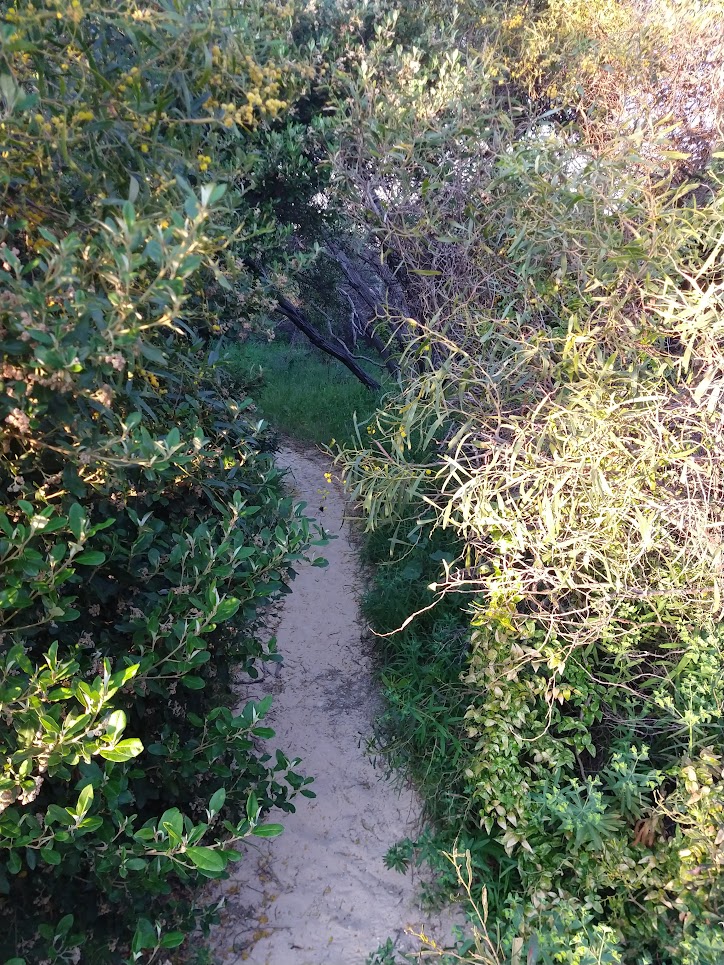

From there, I came up with two new couplets:
Always follow secret tracks
The paths that wind and wend through cracks
Always test a secret door
You never know just what they’re for
Together, these couplets suggested the idea of a journey, and so I began to gather and shape rhymes that seemed to fit that general idea. All the while, though, I wasn’t sure what this was, whether it was anything at all, that maybe it was all too loose to make a picture book, that it needed a more concrete narrative than I felt willing to suggest. I was thinking of setting it aside, relegating it to the too-hard – or too-weird – basket, when, musing on what shape a journey might take, I came up with:
Never worry that you’re stuck
Especially if you’re with a duck!
And just like that, I was all in. I still had no idea what this was going to be or how it might get there, but I was now fully committed to doing whatever it took, simply because I had to see this hypothetical duck somehow saving the day. I had no notion at the time of what a difficult task I was setting for an illustrator. The manuscript went off as a series of couplets that loosely suggested the idea of a little explorer setting off on an adventure, running into various troubles and eventually making it home again, somehow thanks to a duck. Thankfully, Leila Rudge was more than equal to the task, bringing rich layers of story and character to the text, creating a glorious world that any intrepid child and their feathered friend would love to inhabit.

In the writing process, there were of course many couplets left on the cutting room floor. Most of them will stay there, but to celebrate the publication of this lovely little book, which I hope will delight readers young and old, I will leave you with this one:
Never, ever act your age
And always turn just one more page!
 Meg McKinlay